
UFC Betting in New Zealand: Where the Law Allows It, How the Odds Are Built, and What Each Operator Actually Offers
 Available in US

New Zealand bettors who search for UFC action land on a market with one door: since 28 June 2025, TAB NZ and its online sister brand Betcha are the only operators allowed to take racing and sports bets, including UFC, from people in New Zealand. That single legal channel is the spine of this page. Around it sit the mechanics — the markets a UFC card carries, how the prices are built, the calculations behind a payout and a margin, the mobile apps, the safer-gambling tools, and the rest of the operator set New Zealand players actually meet, which is mostly offshore and, by design of section 74AAA of the Racing Industry Act 2020, not licensed to take those bets here.
Currency snapshot — as of October 30, 2026, the operator and licence claims above were checked against the New Zealand Department of Internal Affairs register and the Racing Industry Act 2020 as published by the New Zealand Government.
The shortlist: ten operators a New Zealand UFC bettor meets, and what each one is
The two lawful brands come first because nothing in New Zealand is above them legally. The remaining eight are listed because punters see their ads, recognise their logos, and sometimes land on their sites — but none of them holds a New Zealand licence to take UFC bets. Mixing the two groups as if they were peers might mislead the reader. The split below keeps them apart, with the same comparison columns applied so the differences in market depth, mobile offering and licensed status sit side by side rather than buried.
| Brand | New Zealand status | What the operator’s own terms say on UFC and the key’s subject |
|---|---|---|
| TAB | TAB NZ brand — one of the two brands lawfully offering racing and sports betting in New Zealand (Racing Industry Act 2020, s74AAA, in force 28 June 2025) | UFC listed among the sports covered; fixed-odds and pool betting; live in-play available through the app; safer-gambling tools (deposit limits, time-outs, self-exclusion) in-app |
| Betcha | TAB NZ brand — one of the two brands lawfully offering racing and sports betting in New Zealand (s74AAA, in force 28 June 2025) | Same betting catalogue as TAB NZ (Betcha and TAB are run from one platform); mobile-first app; safer-gambling tools inherited from TAB NZ |
| Rabona | Not licensed in New Zealand — Curaçao licence holder, no right to take bets from people in New Zealand | Combat sports listed among the sportsbook’s markets; over 30 market types per event on the wider sportsbook; pre-match and live |
| RoyalistPlay | Not licensed in New Zealand — Tobique Gaming Commission e-gaming licence, no right to take bets from people in New Zealand | Sportsbook covers football, basketball, tennis, handball, ice hockey, volleyball, table tennis; live betting, sports promotions, results and a schedule visible on the home page; combat sports coverage is not separately stated |
| BillyBets | Not licensed in New Zealand — no licence that applies in New Zealand is named | Sportsbook under one combined account with the casino; lists football, tennis, table tennis, basketball, ice hockey, American football, baseball, combat sports, esports, virtual sports and live betting |
| Winz.io | Not licensed in New Zealand — Anjouan and Tobique licences, no right to take bets from people in New Zealand | A sports betting bonus promotion is run with its own Sportsbook T&C, Sports Rules and Bonus Terms pages; combat sports depth not separately stated |
| 22Bet | Not licensed in New Zealand — Curaçao licence (8048/JAZ), no right to take bets from people in New Zealand | Over 30 market types per event, including 1X2, Double Chance, totals, both teams to score, correct score, HT-FT, plus tennis game, set and handicap markets; UFC market breadth not separately stated |
| Sportaza | Not licensed in New Zealand — Anjouan licence (ALSI-202606064-FI2), no right to take bets from people in New Zealand | Cash out before settlement, Bet Builder (a void leg voids the whole slip), multiples, Asian lines, interval markets in 1/5/10/15-minute windows |
| Thunderpick | Not licensed in New Zealand — Curaçao licence (OGL/2024/677/0722), no right to take bets from people in New Zealand | Esports-first — CS2, League of Legends, Dota 2, Valorant; sportsbook adds cash-out and Champions League to NFL markets; combat sports coverage is not separately stated |
| BetNinja | Not licensed in New Zealand — Union of the Comoros licence, no right to take bets from people in New Zealand | A 100% sportsbook match on the first deposit up to EUR 100 stated in the casino welcome terms; UFC market depth not separately stated |
TAB: the lawful heavyweight
TAB NZ has been the legal racing and sports betting monopoly in New Zealand since 28 June 2025, and the brand is the longest-established face of that monopoly. The partnership with Entain, signed in 2023, gives Entain a 50/50 share of gross profits over 25 years, with TAB NZ guaranteed at least $150m a year for the first five years and Entain paying a one-off $100m into the racing sector. The brand carries UFC among the sports covered, supports fixed-odds and pool betting, runs live in-play through the app, and integrates safer-gambling tools — deposit limits, time-outs and self-exclusion — directly in the product.
For a New Zealand punter who wants the cleanest legal path to a UFC card, TAB is the obvious starting point. The wagering catalogue inherits everything TAB NZ publishes, which means the same market list as Betcha, the same minimums, the same settlement rules. TAB also has the wider retail footprint of the two brands — a network of outlets that still takes a punt — so a bettor who prefers a printed slip over a phone has a fallback.
What the brand is less sharp on: the mobile app, with a 17+ age rating, is positioned for racing and rugby first, and the UFC market depth, while present, is not the headline of the platform. The two lawful brands also share one set of safer-gambling settings, so a self-exclusion applies across both.
Betcha: the mobile-first sibling
Betcha is the newer of the two TAB NZ brands, first released on the New Zealand App Store on 6 August 2024 and run by Entain New Zealand Limited. It is, in law and in product, the same operator as TAB — one platform, two front doors — so every market on TAB is on Betcha, and every safer-gambling setting carries across.
Where Betcha earns its place is the form factor. The app is built mobile-first rather than adapted from a retail product, and the user journey is closer to a polished international sportsbook than a national-tote app. For a New Zealand punter who already has a TAB account and wants a second channel to the same bets — say, one app for racing, one for UFC — Betcha is the natural pair.
The same caveat applies: no New Zealand-licensed rival exists, so the value comparison is against TAB itself, not against other lawful bookmakers. The strongest reason to pick Betcha is the form factor; the strongest reason to pick TAB is the retail network and the longer track record.
Rabona: the offshore fighter, combat sports on the menu
Rabona launched on 23 December 2019 as the sixth online sportsbook of the Soft2Bet group and lists combat sports among its markets. The brand is not licensed in New Zealand — it names a Curaçao licence, which gives it no authority to take bets from people in New Zealand under section 74AAA. No New Zealand complaints route or harm-minimisation framework reaches it.
The sportsbook is broad — over 30 market types per event on the wider menu — and the pre-match and live in-play offering is mature. For a New Zealand punter who already has a TAB account and is curious about a deeper market card, the gap is the legal one: betting with Rabona from New Zealand puts the operator, not the player, on the wrong side of the law, and there is no New Zealand regulator to complain to if a payout stalls.
A clean fit, then, is a bettor with a TAB NZ account for the actual bet, using Rabona only as a price-comparison reference and a sanity check on how deep a market list can run.
RoyalistPlay: light sportsbook, no stated UFC menu
RoyalistPlay’s home page describes a sportsbook built around football, basketball, tennis, handball, ice hockey, volleyball and table tennis, with a separate e-sports section and a Predictions page. Live betting, sports promotions, results and a schedule sit on the same screen. Combat sports, and UFC in particular, are not separately named.
The brand operates under a Tobique Gaming Commission e-gaming licence (No. 0000002), held by Novatrix SRL. That licence provides no standing for the operator in New Zealand, and no New Zealand complaints route or harm-minimisation framework reaches the operator. The home page suggests a bookmaker that has not pushed into combat sports, and the UFC reader’s needs are not its centre of gravity.
For a New Zealand punter, the case for opening an account is thin even by the standards of the offshore group — the catalogue is narrower, the UFC markets are unstated, and the legal status is the same as the others. RoyalistPlay is a brand a reader may meet on a comparison list; it is not a brand the UFC market routes to.
BillyBets: one account, casino and sports together
BillyBets runs a casino and a sportsbook under one account. The sportsbook’s listed sports are football, tennis, table tennis, basketball, ice hockey, American football, baseball, combat sports, esports, virtual sports and live betting. Combat sports is named, which is a step ahead of RoyalistPlay for the UFC reader.
The brand names no licence that applies in New Zealand, so the same warning as for the rest of the offshore group applies — it lacks authority to operate here under section 74AAA, no New Zealand complaints route, no harm-minimisation framework that reaches it. The single-account convenience is the structural pitch: a bettor who already plays slots and tables does not need a second wallet to add a UFC multi.
The trade-off is the legal exposure of the operator and the absence of a New Zealand regulator, which is the same trade-off the whole offshore group carries.
Winz.io: a separate Sportsbook T&C, the rest left unstated
Winz.io runs a sports betting bonus promotion under a separate Sportsbook T&C, with a Sports Rules page and a Bonus Terms page sitting alongside the main casino terms. The brand names Anjouan and Tobique licences, both held by Novatrix SRL, neither of which permits it to accept bets from New Zealand customers.
The structural detail matters more than the UFC depth for this entry: a separate sportsbook T&C is a small signal that the operator has thought about the sports side as its own product rather than a tab on the casino, and that a New Zealand punter who does try the site will find a settlement-rules page to read before staking. Combat sports market depth, though, is not separately stated.
For a reader weighing Winz.io, the case is the same shape as the rest of the offshore set: a different licence footprint, no New Zealand protection, the operator’s own terms as the only rulebook.
22Bet: the catalogue is deep, the UFC line is not separately stated
22Bet offers over 30 market types per event — 1X2, Double Chance, totals, both teams to score, correct score, HT-FT for football, and game, set and handicap markets for tennis. The breadth is the pitch. The brand names a Curação licence (8048/JAZ) held by TechSolutions Group N.V., which does not authorise it to operate in the New Zealand market.
The gap for the UFC reader is that the catalogue figure is not broken out by sport, and the brand does not separately state how deep its UFC menu runs. For a New Zealand punter, the trade is once again between the depth of a foreign sportsbook and the absence of a New Zealand regulator; 22Bet’s depth is real, the regulator’s absence is also real, and the reader weighs both.
Sportaza: cash out, Bet Builder, interval markets
Sportaza lists cash out before settlement, Bet Builder (where a void leg voids the whole slip), multiples, Asian lines and interval markets in 1, 5, 10 and 15-minute windows. The Anjouan licence (ALSI-202606064-FI2) provides no standing in the New Zealand jurisdiction.
The interesting feature for the UFC reader is the Bet Builder: a single-card multi on method of victory, round grouping and over/under rounds is exactly the kind of structure the modern sportsbook pitches. Asian lines and interval markets sit awkwardly on a three- or five-round fight, but the technology is there, and the reader who wants a same-game multi on a UFC card has a clear feature to look for. The legal status is the same as the rest of the offshore group.
Thunderpick: esports-first, sportsbook as the supporting act
Thunderpick is positioned as an esports-first operator — CS2, League of Legends, Dota 2 and Valorant — with a sportsbook that adds cash-out and a market range from the Champions League to the NFL. The Curaçao licence (OGL/2024/677/0722) is held by Paloma Media B.V., and the brand lacks authorisation to operate for New Zealand residents.
For the UFC reader, the case is the support act, not the headline: a sportsbook that exists to round out an esports account rather than to lead a card. Combat sports market depth is not separately stated. A New Zealand punter whose primary interest is the UFC will find the same offshore-only trade-off with a thinner UFC line than some peers.
BetNinja: a stated 100% sports match, UFC line unstated
BetNinja advertises a 100% match on the first deposit up to EUR 100 in its sports terms, alongside a casino welcome of EUR 1,000 in bonus and 100 free spins. The brand names a Union of the Comoros licence, which offers no standing to operate for New Zealand customers. UFC market depth is not separately stated.
The stated match is the headline and the only point on which a New Zealand reader has a number to work with. The legal status is the same as the rest of the offshore group. The offer is the kind that reads well in a banner and reads less well when the wagering terms are read in full, which is the pattern the rest of this page returns to more than once.
UFC fundamentals: the rules a price is built on
UFC has been running since its first event on 12 November 1993 in Denver, Colorado; it is owned and operated by TKO Group Holdings, and Dana White has been president since 2001. By 2026 the promotion had held over 750 events across eight men’s and three women’s divisions. The schedule inside a year is dense enough that there is rarely a quiet month, and the calendar in front of a New Zealand punter usually carries a numbered event every few weekends.

What sits underneath the prices is a structure of three or five rounds. Each round is a maximum of five minutes long, with one minute’s rest between rounds. Championship fights and non-title main events are scheduled for five rounds; other bouts for three. A bout can end by submission, knockout, technical knockout, judges’ decision — unanimous, majority, split or technical — or disqualification; a no contest is also a possible ruling.
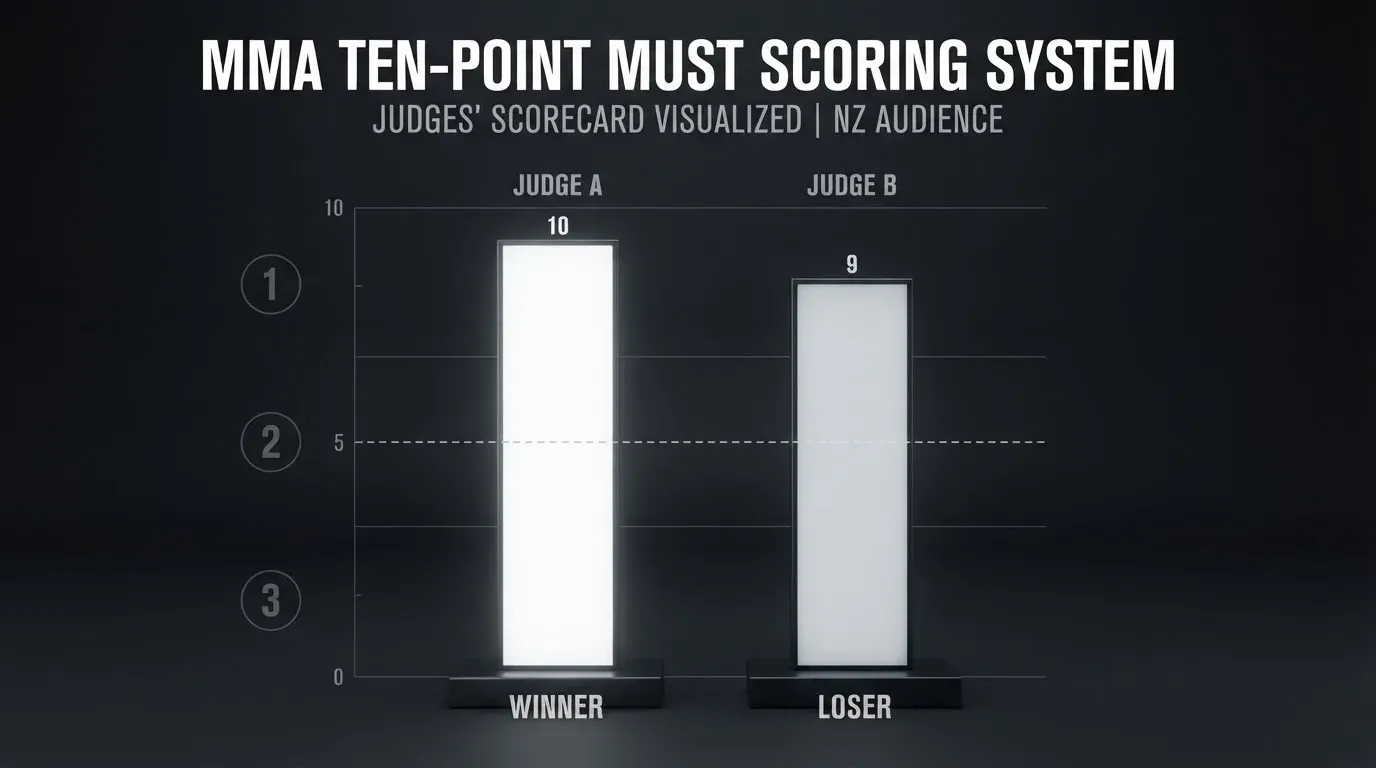
The scorecard that decides a fight that goes the distance is the ten-point must system. Three judges score each round, the winner receiving ten points and the loser nine or fewer; a 10-8 round is typical for a dominant round. If a title fight ends in a draw, the defending champion retains the belt. Each of those rules is a small lever on how a market is priced — a five-round fight opens different over/under lines than a three-round one, a title fight opens a draw market, a one-sided round pushes a method-of-victory price.
The UFC fixture list 2026: what the calendar looks like
UFC 334 (Gane vs. Hokit) is scheduled for 14 November 2026 at Madison Square Garden, New York City, and UFC 335 (Oliveira vs. Lopes) for 12 December 2026 at T-Mobile Arena, Las Vegas. The numbered events are the spine; around them sit Fight Night cards, the Contender Series, and the occasional special event, with the full year typically running more than forty events.
For a New Zealand punter the time-zone cost is real. A pay-per-view main card that starts at 10:00 PM Eastern in the United States is the early hours of the next day in New Zealand, and the undercard earlier in the evening local time is the late night before. The same TAB NZ app that takes a pre-match bet a day earlier takes the live in-play price as the fight unfolds, which is the only practical answer to the clock.
What may be bet on at TAB NZ, and how a UFC price is built
TAB NZ takes fixed-odds and tote (pool) bets, with the published betting rules covering the racing bet types — Win, Place, Each Way, Quinella, Exacta, Trifecta, First Four, Double, Treble, Daily Double, Running Double, Quaddie and Big6 — and the multi structures: Multis and Same Game Multis, where the legs all sit on one event. For UFC, the live in-play market is listed in the TAB NZ apps; any statutory restriction on in-play markets is not established.
What is not established is also worth saying. There is no lawful New Zealand betting exchange, and spread betting sits outside TAB NZ’s sports-betting definition. Bets on politics and novelty markets are not established. There is no statutory per-bet cap; limits come from TAB NZ’s own terms, not from the Act. The prohibition covers events held inside and outside New Zealand. Whether esports betting counts as sports betting under the Racing Industry Act is not established; virtual sport is treated by the 2026 online casino law as casino gambling.
The market list on a UFC card at TAB NZ follows the international sportsbook norm: moneyline (the outright winner), method of victory (KO/TKO, submission, decision), over/under rounds, and the same-game multi that lets a bettor stack method and total on one slip. The depth is the operator’s call, the rules are the operator’s call, and the price is the operator’s call.
How a two-way price hides a margin
The bookmaker’s margin is the share of every dollar bet on a market that the bookmaker keeps, on average, across a large number of bets. The cleanest way to see it is on a two-way market with decimal odds 1.90 on each side. The payout share — what comes back to bettors, in total, per dollar staked — is 1 divided by the sum of the reciprocal odds: 1 ÷ (1/1.90 + 1/1.90). That sum is 1.0526, so the payout share is 0.9500, or 95.00%. The margin is 1 minus the payout share, which is 0.0500, or 5.00%. A 5% margin on a perfectly even two-way market is the kind of number a well-run bookmaker posts on a liquid moneyline; a less efficient market — a method-of-victory line, a round grouping, a same-game multi — carries a higher margin because the price is harder to sharpen.
The 1.90/1.90 pair is an example, not a quoted price. Real UFC moneyline prices rarely sit that low on a fight the market is split on, and a heavy favourite sits at shorter odds on one side and longer on the other. The arithmetic is the same, the inputs change, and the margin in the price is the thing a sharp punter is always reading.
How a winning payout is worked out
The return on a winning single bet is the stake multiplied by the decimal odds. A $10 bet at $2.10 returns $21.00, of which $10.00 is the stake and $11.00 is the net profit. A combination bet multiplies the decimal odds of the legs into one price — three legs at $2.10, $1.85 and $1.95 return $7.58 per dollar staked, so a $10 multi returns $75.80 ($65.80 net). The math is the same on a single or a multi; the difference is that every leg has to win, and the more legs the higher the implied margin the bettor is paying.
The TAB NZ app shows the decimal odds beside the bet, the stake the bettor enters, and the potential return before the bet is confirmed. The rules settle the bet, and the same rules decide what happens when a fighter is replaced, when a bout is ruled a no contest, or when a weight miss moves the fight.
The legal frame: what the law says, who it covers, and what it does not
The Department of Internal Affairs is the gambling regulator under the Gambling Act 2003 and monitors compliance with the betting prohibition. The Racing Industry Act 2020 establishes TAB NZ as the sole betting provider for racing and sports in New Zealand. The Racing Industry Amendment Act 2025 inserted section 74AAA, in force on 28 June 2025, which says no person other than TAB NZ may offer racing betting, sports betting or other racing or sports betting to a person in New Zealand, regardless of where that person is resident or incorporated; DIA told providers serving New Zealand to withdraw with immediate effect.
There is no licensing route for another bookmaker and no licence register for betting, because there is only one lawful operator. The law does not geo-block offshore websites; it puts liability on the offshore operator. TAB and Betcha are the two lawful online brands of TAB NZ, run by Entain under the long-term partnership cited earlier; they are not rivals, and the comparison page that treats them as such is misleading.
The Online Casino Gambling Act 2026 licenses online casino gambling only. TAB New Zealand winning the right to apply for a casino licence does not extend the betting monopoly. Greyhound racing is closing in stages from 1 August 2026, and from that date offshore operators may not take bets on greyhound races either.
What it means for the offshore group on the shortlist
Each of the eight offshore brands on the shortlist is in the position the law targets: the operator, not the player, is on the wrong side of section 74AAA. No prosecution of an offshore bookmaker was found in the public record, and the penalty for breaching the section is not stated in the section itself. New Zealand does not block bookmaker sites, so the access question is a separate one from the legality question.
For the player, section 19(4) of the Gambling Act 2003, inserted in 2025, says an individual may not be convicted for placing a bet with an offshore betting operator in breach of section 74AAA. No source states a penalty for a player, and the honest framing is the one the Act allows: the law targets the operator, DIA warns players of the risks, and no published penalty for a player was found. It is not right to say that betting offshore is illegal for the player, and it is not right to say it is legal. The right framing is the asymmetry: TAB NZ and Betcha are the only lawful option, with New Zealand harm-minimisation tools, regulator oversight and a complaints framework; offshore is unlawful for the operator to serve New Zealand, with no New Zealand complaints route, the risks DIA states, and the limits that may apply in the operator’s own jurisdiction.
Tax, advertising and the small print
For the player, Inland Revenue guidance says recreational gambling winnings are generally not taxable and prize money from TAB horse, dog and trotting races is not taxable; a person who bets as a business is a different case, and the general advice is to consult Inland Revenue or an accountant. For the operator, TAB NZ pays the Problem Gambling Levy of 0.74% in force from 1 July 2025 to 30 June 2028; overseas operators supplying New Zealand residents pay online gambling duty of 12% of profits since 1 July 2024, rising to 16% from 1 January 2027. A duty being payable does not make an offer lawful, and the page does not write that paying the duty shows a bookmaker is legal. The point-of-consumption charge on offshore racing and sports bets ceased on 30 June 2026.
The Advertising Standards Authority’s Gambling Advertising Code applies to betting advertisements: ads must not target children (under 14) or young people (14 to under 18), judged by context, appeal and expected audience, must not encourage harm, and must be truthful with terms available. No New Zealand equivalent of a whistle-to-whistle ban for betting was found. TAB NZ runs bonus-bets promotions; no New Zealand rule on bet-bonus size or wagering terms was found, and the only place to find a number is TAB NZ’s own terms.
Safer gambling at TAB NZ: tools, the age rule, and where to get help
The age for TAB NZ betting is 18. Betting under 18 is an offence under section 89 of the Racing Industry Act 2020. Land-based casinos are 20, and the two ages do not merge. TAB NZ accounts need a verified New Zealand address and ID, and the account-opening flow is the place the age and identity checks sit.
The safer-gambling tools the TAB NZ app carries are deposit limits, time-outs and self-exclusion. A self-exclusion applies across the two brands, so a punter who has self-excluded from TAB is also self-excluded from Betcha, and vice versa. The free Gambling Helpline is 0800 654 655 with the text line 8006, and Safer Gambling Aotearoa is the public-facing harm-minimisation body. There is no single national online-betting exclusion register; the register the casino law will require is for online casinos only.
For the offshore group, the safer-gambling framework is whatever the operator’s own licence and house rules say. None of the eight reaches the New Zealand complaints route, and none of them is bound by the New Zealand harm-minimisation framework. The page does not describe an offshore brand as a “safe” option by default, and the honest framing is the one already given: the operator is on the wrong side of section 74AAA, no New Zealand regulator is the backstop, and the bettor’s recourse is the operator’s own complaints process or the regulator in the operator’s own jurisdiction.
The mobile and app side: TAB, Betcha, and the rest
The TAB NZ app, published on the New Zealand App Store under the seller name New Zealand Racing Board, was first released on 8 September 2014. The app covers horse and harness racing, rugby union and rugby league and other sports, pre-match and live, and carries a 17+ age rating while stating customers must be 18 or over to bet. The app includes Trackside live race streaming with in-app betting, racing form, Blackbook and Jockey Challenge tools, and a simplified wallet for deposits and withdrawals.
The Betcha app, published by Entain New Zealand Limited and first released on 6 August 2024, is the mobile-first sibling — the same betting catalogue as TAB NZ but a different interface. For a New Zealand punter who wants a sportsbook-shaped app rather than a tote-shaped one, Betcha is the cleaner fit; for a punter who wants the older product with the wider retail fallback, TAB is the fit.
The offshore group runs international mobile products, all of which work on a New Zealand handset but none of which is built around the New Zealand market. The legal caveat is the same as the desktop caveat, and the app store rating is the app store rating of the country the operator targets, not New Zealand.
Reading TAB NZ’s bonus-bet terms without the marketing
“Bonus bet” is the marketing word, and the page is the place to read past it. A TAB NZ bonus bet is a credit the operator stakes on the bettor’s behalf; the stake is usually not paid back with a win, so a $10 bonus bet at $2.10 returns the $11.00 net profit and not the $21.00 a $10 cash stake at the same odds might return. The offer is the chance to place a bet without committing the cash, and the price of that chance is the lost stake.
The market a bonus bet is placed on carries a margin the same way a cash bet does, and the value of the bonus bet is the value of the odds on the market chosen, discounted for the lost stake and the margin. The calculation is the page’s explanation of the offer, and the answer it gives is the same shape as the answer for a free bet anywhere: a bonus bet is worth more on a longer-priced winner on a market with a thinner margin, and it is worth less on a heavy favourite on a market with a fat one.
No New Zealand rule on bet-bonus size or wagering terms was found, so the only number on the page is the one TAB NZ’s own terms publish. The page does not print a working promo code, and the bettor who wants the live terms reads them on TAB NZ’s own pages before staking.
Picking an operator for UFC: what actually decides it
For a New Zealand punter, the choice is not between ten brands of the same kind. The two lawful brands are one operator group, run from one platform, and the comparison between TAB and Betcha is the comparison between two doors to the same shop. The real choice is the door, and the decision is the form factor: TAB for the longer track record and the retail fallback, Betcha for the newer mobile product.
The offshore group is a different kind of decision. The price the operator is offering and the depth of the market are real, the absence of a New Zealand licence and a New Zealand complaints route is also real, and the punter who chooses an offshore book is making a trade the page does not dress up. The trade is the trade DIA warns about, the trade the operator’s own licence and complaints process is the only backstop for, and the trade the New Zealand punter makes with a clear view of the two sides.
The cleanest read on the shortlist, then, is the order it sits in: the two lawful brands first, the offshore group after, and the comparison columns the same on every row so the legal status is the first thing the eye lands on, not the last.
Predictions, tips, and the line a tipster cannot cross
A UFC bet is a bet on an outcome nobody can know in advance, and the search phrases that promise a “best bet” or a “sure thing” are promising something the page does not have. What the page can do is name the inputs a sharp price is built on — form, reach, age, recent cardio, the result of the last three fights, the camp, the weight cut, the round the fight is likely to end in — and leave the rest to the bettor’s own read.
The bankroll frame is the one piece of the conversation the page can carry. A punter who stakes a fixed share of the bank on every bet, who records the bets and the closing prices, and who reads a closing line move as a signal rather than a tip is doing the work a tipster shortcut pretends to do. The UFC reader who lands on the page with a tip in mind is better served by reading the tip against the closing line and the market margin than by following the tip on its own.
The page does not name a winner of a UFC fight. It does not run a model, publish picks, or quote a tipster. The market margin and the closing line are the inputs the bettor works with, and the rest is the bettor’s own.
The bet types a UFC card carries
The moneyline — the outright winner — is the spine of a UFC card. The method of victory — knockout or technical knockout, submission, decision — is the second market a sportsbook prices, and the round grouping — fight ends inside the distance, fight goes the distance, over or under a round count — is the third. The same-game multi stacks these on a single slip, with the catch that every leg has to win and the multiplied price carries a higher margin than any single leg.
For a New Zealand punter the bet slip is the TAB NZ or Betcha slip on the phone, the stake is the stake entered, the decimal odds are the odds displayed, and the potential return is the return the slip shows before the bet is confirmed. The rules are the operator’s, and the settlement is the operator’s, and the page describes the structure rather than the specific line on a specific fight.
The bettor who wants a wider market list — a wider method-of-victory tree, deeper round groupings, more same-game multi legs — reads the operator’s own UFC page before staking, because the catalogue is the operator’s call and not the law’s.
Where the data stops, and where the bettor checks
The page carries the facts research carries, and the facts stop where the inputs stop. The UFC market list on TAB NZ and Betcha, the exact decimal price on a named fight, the bonus-bet terms in force, the payment methods accepted and the deposit limits in force are all on the operator’s own pages and not on this page. The bettor who wants the live price, the live catalogue and the live terms reads them on TAB NZ’s and Betcha’s apps and on the offshore operator’s own site.
The honest read on the offshore group is the same: the catalogue and the price are on the operator’s own pages, the legal status is on this page, and the bettor who chooses the offshore route does so with the legal status on the table.
Frequently asked questions about UFC betting in New Zealand
Can UFC fighters bet on fights?
Athletes and event personnel are subject to combat-sport integrity rules, and a fighter betting on a fight they are in is a prohibition under those rules, not a prohibition the betting operator enforces. A fighter betting on a fight they are in is a different matter from a fighter betting as a customer of a licensed bookmaker, and the integrity framework is the body the question belongs to.
Can UFC fighters bet on other fighters?
The same integrity framework governs, and the line is the same: a fighter betting on a fight they are connected to is a problem the integrity body polices, while a fighter placing a bet as a private customer on a fight with no connection to them sits in a different place. The page does not summarise a specific rule; the integrity body is the body the question belongs to.
How do you bet on the UFC from New Zealand?
The lawful path is to open an account with TAB NZ or Betcha — the two online brands of the only operator that may take racing and sports bets from people in New Zealand under section 74AAA of the Racing Industry Act 2020 — and place the bet through the app or website. The bettor funds the account, picks the fight and the market, enters the stake, confirms the slip, and the bet is settled under the operator’s rules after the fight.
Which bookmaker may lawfully take sports and racing bets in New Zealand?
TAB NZ, through its two online brands TAB and Betcha, is the only provider lawfully offering racing and sports betting to people in New Zealand since 28 June 2025 under section 74AAA of the Racing Industry Act 2020. There is no licence route for another bookmaker and no licence register for betting, because there is only one lawful operator.
How is the return on a bet worked out from the stake and the odds?
The return on a winning single bet is the stake multiplied by the decimal odds. A $10 bet at decimal odds of $2.10 returns $21.00, of which $10.00 is the stake returned and $11.00 is the net profit. A combination bet multiplies the decimal odds of the legs into one price, so three legs at $2.10, $1.85 and $1.95 return $7.58 per dollar staked, and a $10 multi returns $75.80 ($65.80 net) if all three legs win.
What is the bookmaker’s margin and how can it be seen in the odds?
The margin is the share of every dollar bet on a market that the bookmaker keeps, on average, across many bets. On a two-way market with decimal odds 1.90 on each side, the payout share is 1 divided by (1/1.90 + 1/1.90), which is 0.9500 or 95.00%, and the margin is the remainder, 0.0500 or 5.00%. A market with shorter prices on both sides carries a thinner margin, and a market with longer prices on both sides carries a fatter one, which is the same statement read from the other side.
Tennis, golf & more – bettinginfo-nz
Content created by the «bettinginfo-nz» team
